Notes 02/23/2026 (Knitting Socks & Painting Paintings about Knitting)

I’ve returned to the studio. This past year pulled me away from painting, though it never truly stopped. Knitting filled the gap and the dexterity it demanded kept me sane. The more I explore the history of knitting and needlecraft, the more meaningful it becomes to me. The origins of needlework are obscure, yet archaeological finds show early humans buried with beaded jewelry and intricate textiles, thought to have served spiritual or decorative purposes and/or essential practical means to protect from the elements. Before all that was the invention of string and thread, a development that shaped human evolution and migration for millennia.

So powerful, in fact, is simple string in taming the world to human will and ingenuity that I suspect it to be the unseen weapon that allowed the human race to conquer the earth, that enabled us to move out into every econiche on the globe during the Upper Paleolithic. We could call it the String Revolution.
— Wayland Barber, Elizabeth. Women’s Work - the First 20, 000 Years : Women, Cloth, and Society in Early Times. New York, W.W. Norton, 1996.

Thread gave us cloth, clothing, netting, just a few of the crucial things that led to the advanced tools and textiles we now take for granted. Industrialization stood to tear down the slowness that this skill requires but it remains to be the touchstone to many people lives as a way of survival. Not just by means of warmth for our skin but to also make human connection and stay present.

Snapdragon Life. “Your Brain Changes When You Make Things - Here’s the Research.” YouTube, 9 Oct. 2025, www.youtube.com/watch?v=X4BKRcqgBY8. Accessed 23 Feb. 2026.

The presence being mentioned is beyond being grounded in the moment but also in a far more encompassing way. Jane Lindsey in this short Youtube video discusses the value in two-handed dexterous activities such as knitting and the benefits to neurological health with age. She has linked her sources and goes into deeper detail in her own words on her wonderful blog- linked here.


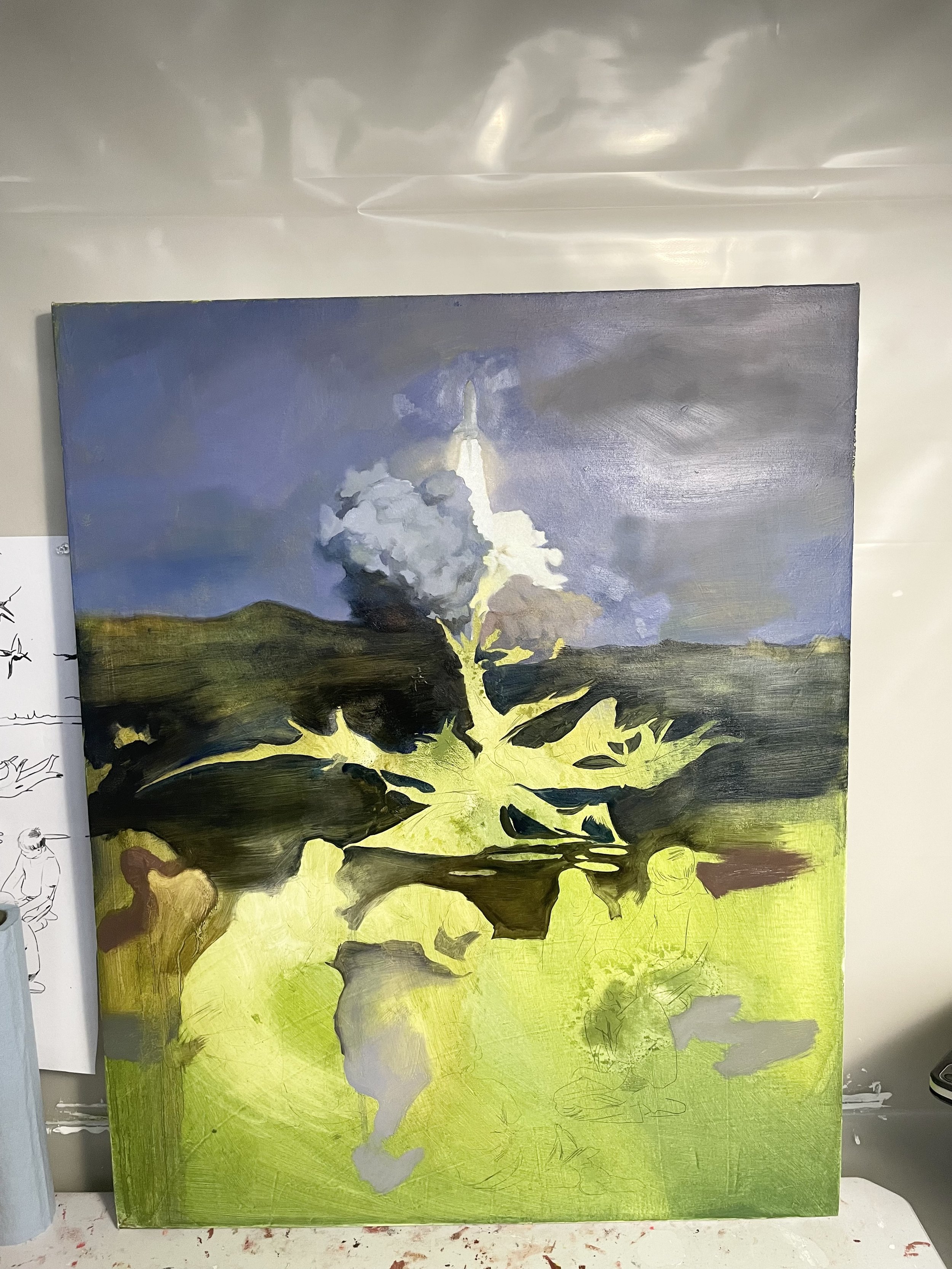
My most recent works in progress explores these ideas through layered, experimental play. (e.g.. slapping some oil paint on a canvas) See below a painting that’s currently in it’s early stages.
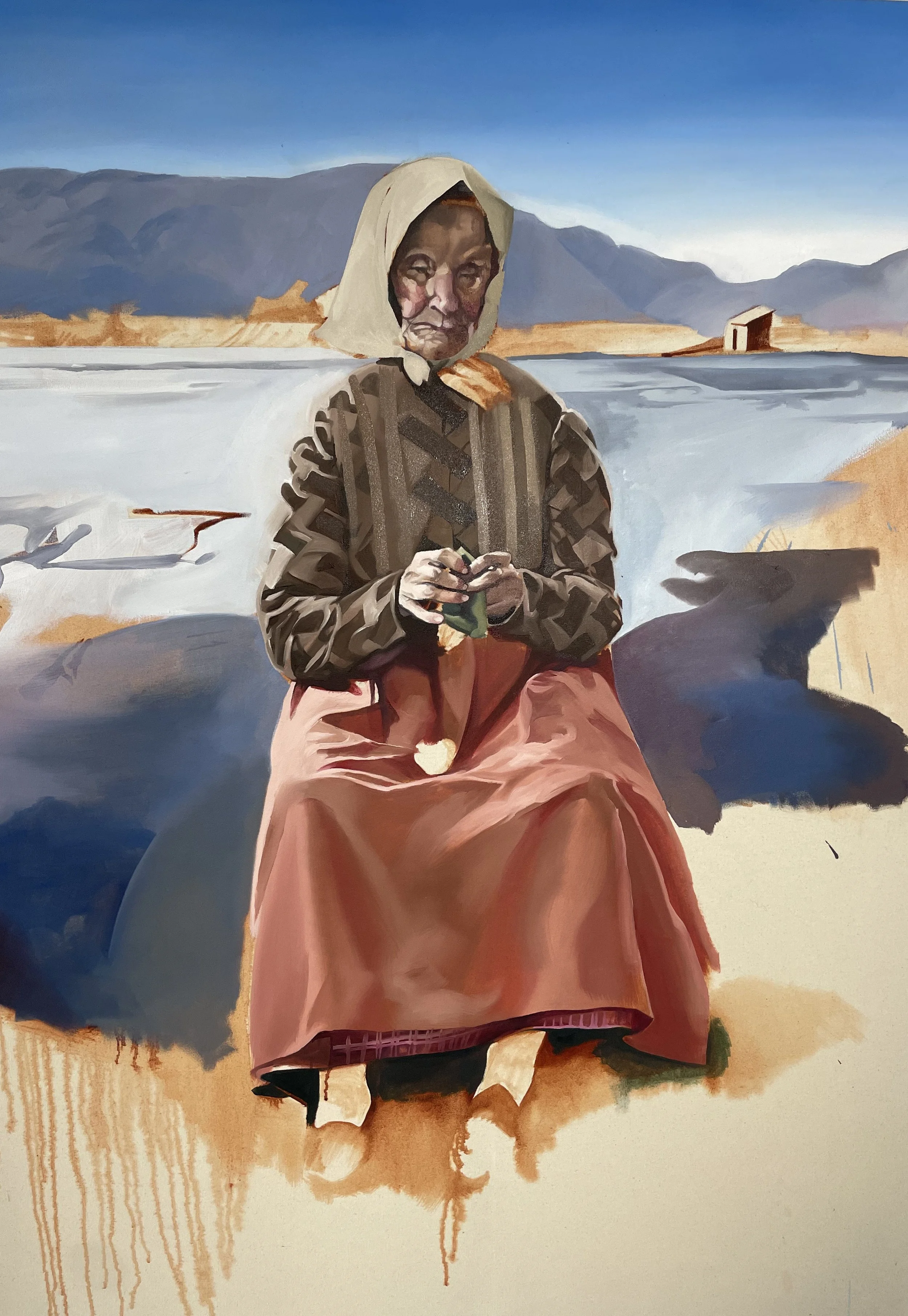
Work in progress. 02/22/2026

My primary reference is an archived 1912 photograph from the Östergötlands Museum by August Christian Hultgren (1869–1961). It depicts Katarina Bram (1820–1919), a resident of the Svinhult’s Bona poorhouse. Local records indicate she suffered poverty and the loss of a spouse; unable to support her disabled daughter on her own, they entered the poorhouse sometime after her husband’s death in 1872. Like many women of the period, Bram likely turned to knitting as a modest source of income. During her life she may have had access to sheep, wool and fleece and spun her own yarn. But the reality in her late life and situation she may have worked with a very small supply of yarn that she repeatedly knit and unraveled, a repetitive task that also helped occupy her mind. It was likely a task she associated with productivity and purpose, a small ritual that tied her to the present. Looping the yarn through familiar patterns, throwing stitches, and swapping out her needles row after row, after a lifetime had become instinctive and quiet.
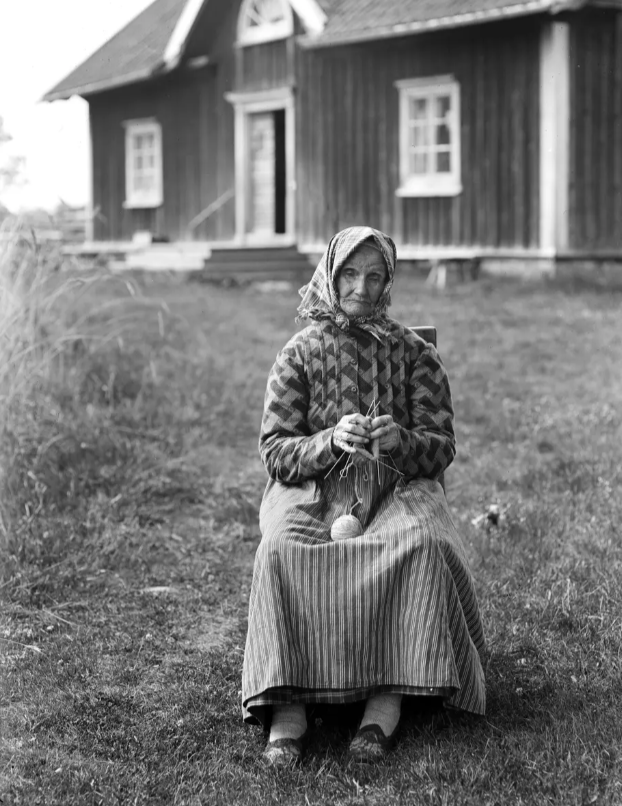
Östergötlands museum. “Katarina Bram (1820-1919),” Digital Museum , 16 May 2016, digitaltmuseum.se/021016422748/katarina-bram-1820-1919. Accessed 23 Feb. 2026.
Notes 02/06/2025 (Seeking some Hope and Sludge in Dead Coal Mines)

Connor and I were scrolling through YouTube a few weeks ago and we had Business Insider videos auto playing while we cooked and ate dinner. There were many highlighting the world’s most expensive art materials, where they come and how they’re made. This video popped up- How to Make Paint from Pollution, it perked up my ears because of the mention of acid rock drainage (ARD).

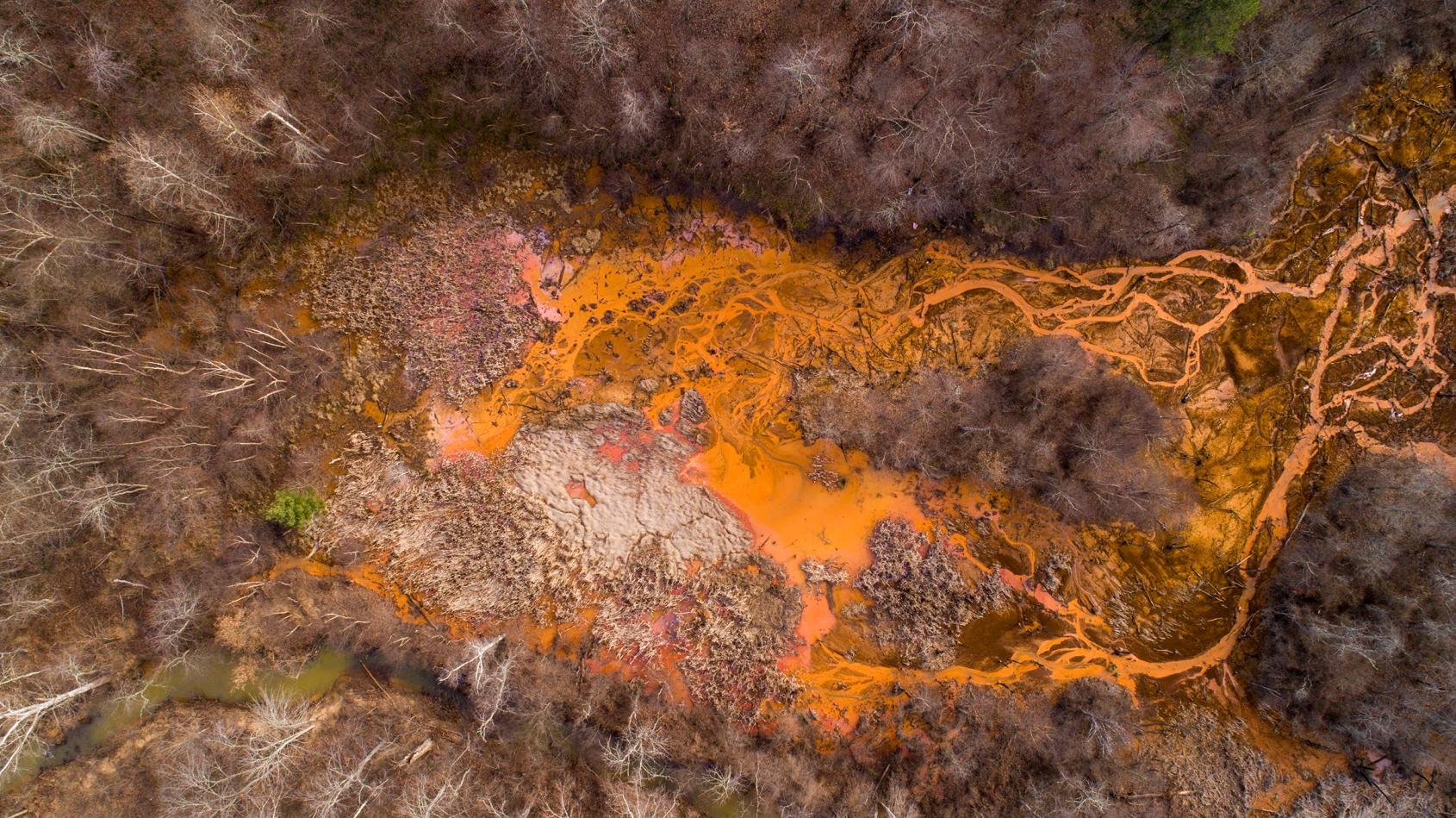
ARD is the release of acidic water from mining operations, which can pollute waterways and harm local ecosystems. When rocks containing sulphide minerals are blasted and exposed to oxygen, the result is high levels of sulphuric acid leaching into groundwater, rivers and lakes. The pH levels of the drainage are affected and can vary depending on many factors, such as exposure to fresh water or other neutralizing compounds. But, in those cases, the neutralization of the drainage can make the soluble iron(III) ions precipitate as iron(III) hydroxide, a yellow, sometimes more orange solid frequently referred to as Yellow Boy. This presence of this colour in waterways has historically been linked to horse deaths, the disappearance of vegetation and dead aquatic life- but ARD is not a historical issue, it’s ongoing.

Aerial view of the acid mine drainage near Oreton, Ohio in 2018. Ben Siegel—Ohio University

The video follows a group called True Pigments out of Sunday Creek in Appalachian Ohio, who utilize water treatment facilities to purify and extract the iron-oxide pigments from the contaminated water flowing out of abandoned coal mines. This effort contributes to Sunday Creek in many ways; restoring clean water, replenishing the local economy with more employment opportunities, expanding the local tax base, and taking pollution and transforming it into a sustainable and profitable product in the form of artist-grade paint.

Image Courtesy of True Pigments

These are available to buy near me, so I’d like to add them to my palette. There’s something morbid about painting with pollution, but I suppose that morbid sentiment can be applied to many other colours. Cadmium is absolutely a contender for the world’s most harmful pigment, but at least in this case the sourcing is a positive act.

There are a handful of ARD sites in Canada such as Britannia Beach in British Columbia and the Proto Mine Tailing site near Elliot Lake in Ontario. University of British Columbia engineers have been working on a large-scale treatment plan for Britannia Beach since 2006 including a water treatment plant and the installation of a concrete plug to halt any other continued flow into the creek. The plant processes an average of 4.2 billion liters of run-off annually, removing an average of 226,000 kilograms of heavy metal contaminants. I’m not sure what they do with their yellow boy sludge, but I kind of want to get my hands on some. Who do I need to call?

While I was taking the EESC_O course I visited the professor during office hours and we spent some time taking about how art and science often overlap. Science and art go hand-in-hand when it comes down to the raw materials, and they also relate in truth-seeking.

If you would like to support True Pigments you can donate or purchase the Reclaimed Earth paints here.

Notes 01/18/2025 (Bodies, Earth, Space)

I did some light research the other morning on types of cosmology and repeating motifs. I had an image in mind that I remember from a History of Religion class I attended. It was the depiction of Nut the Egyptian sky goddess in the GreenField Papyrus . I’ve been reflecting on how throughout history we’ve interpreted natural phenomena as gendered bodies- Moon as Thea (her), Sky as Nut (her), Sun (in romanic languages is male). The Christian God is believed to be a man and he is said to have created the world in his image - but “Mother Earth” is a term often used as well. Thinking about music, metronomes, tempos and heartbeats are related and measurements have always been in relation to the human body (foot, length, pace, hair, arms length) Historically, people in various fields of study like to name discoveries after themselves. (Look at this list.) It’s awfully human-centred.

Book of the Dead of Nestanebetisheru; frame 87.

Image Source: British Museum

It’s not only on a human bodily level- it’s also at a planetary level. Aristotle’s cosmology centred Earth (Terra) in the centre of the understood universe, and the Sun was believed to have rotated around us alongside the other celestial bodies in our solar system. Thanks to Galileo we no longer rely on the Aristotelian model. But we did continue to refer to the Great Chain of Being well into the Middle Ages and into the early Modern period - which creates a hierarchy placing God first, angels second, and humans third above animals, plants, and minerals.

1579 drawing of the Great Chain of Being from Didacus Valades [es], Rhetorica Christiana

I took an Earth Science course this past semester, as a required credit. We started the course with reviewing geological time and the Big Bang Theory. The Universe has been given an age of roughly 12.8 billion years old, while the Earth is estimated to be about 4.6 billion years old. To grasp the enormity of that timescale, we’ve broken it up into Eons, Eras, Periods and Epochs. As a reference, the professor told us to raise our arms up horizontally and to think of the Geological Timescale starting at the tip of the middle finger on one arm, and ending on the fingertip of the opposite side. Human history is the trimmed distal free edge of the fingernail- the white crescent part. (Another example of a bodily measurement!) It was a good learning tool, and a reminder of our relative insignificance, it’s scary, but, humbling.

We remain to bend at Earth’s will with the powerful climate system, and the tectonic plates which slide around unpredictably on the lithosphere. We have no way of predicting earthquakes, only the ability to measure them and pin-point the epicentre and hypocentre after the fact. The waves that are produced by tectonic movements are called S-Waves (surface) and P-Waves (primary/body), there are also Love-Waves and Raleigh-Waves. S-waves and P-waves travel through the Earth’s interior, and that’s been a big factor in figuring out what state each layer of the Earth is. Since particular waves can travel through liquids, while some cannot. I listened to a lecture from a Hawaiian geology professor, where he said that there’s been a scientific dream scenario where we can create more of these waves to get better readings about the Earth’s interior - but we’d only be able to do that successfully by detonating hundreds or thousands of atomic bombs on the surface. We’d like to think that gaining control over these things would be a benefit, but maybe it’s for the best we leave that up to the powers/systems that be? I ask these questions a lot- Why do we need to know everything? Why must we dominate everything?

Space frightens me, I believe it’s a healthy fear. Our bodies are composed of elements that come from the Earth, we evolved to breathe sustenance from the atmosphere, drink water that cycles in the climate system, and we die, and decompose to become a part of the carbon cycle, gravity is vital in our fetal development, and circulatory system. Deep in my bones (figuratively, literally) I believe we should not mess with anything outside our atmosphere. There’s a reason why space travel is so hard on the body, it’s not meant for us. There’s a kind of body horror when the concept of a baby being conceived and born in space is actually objectively looked into. Astronauts who experience technological failure outside of orbit and loose contact with home will never be found again. We may think our technologies will become foolproof, but there’ll always be human error.

The Fall of Icarus. Antique fresco from Pompeii, 40–79 AD


Studio Log 01/16/2025

I made some marks on a 20X24” canvas today that I’ve spent the last month priming with the Gamblin Oil Ground. I did about four coats total (thick) and applied it with a silicone wedge tool. I really like the surface quality, it’s borderline pore-less but still has some absorbency.

First strokes are down, I foresee this image changing but I wanted to start here.